A financial bubble1 is a market aberration manufactured by government, finance, and industry, a shared speculative hallucination and then a crash, followed by depression. Bubbles were once very rare—one every hundred years or so was enough to motivate politicians, bearing the post-bubble ire of their newly destitute citizenry, to enact legislation that would prevent subsequent occurrences. After the dust settled from the 1720 crash of the South Sea Bubble, for instance, British Parliament passed the Bubble Act to forbid “raising or pretending to raise a transferable stock.” For a century this law did much to prevent the formation of new speculative swellings.
Nowadays we barely pause between such bouts of insanity. The dot-com crash of the early 2000s should have been followed by decades of soul-searching; instead, even before the old bubble had fully deflated, a new mania began to take hold on the foundation of our long-standing American faith that the wide expansion of home ownership can produce social harmony and national economic well-being. Spurred by the actions of the Federal Reserve, financed by exotic credit derivatives and debt securitiztion, an already massive real estate sales-and-marketing program expanded to include the desperate issuance of mortgages to the poor and feckless, compounding their troubles and ours.
That the Internet and housing hyperinflations transpired within a period of ten years, each creating trillions of dollars in fake wealth, is, I believe, only the beginning. There will and must be many more such booms, for without them the economy of the United States can no longer function. The bubble cycle has replaced the business cycle.
Such transformations do not take place overnight. After World War I, Wall Street wrote checks to finance new companies that were trying to turn wartime inventions, such as refrigeration and radio, into consumer products. The consumers of the rising middle class were ready to buy but lacked funds, so the banking system accommodated them with new forms of credit, notably the installment plan. Following a brief recession in 1921, federal policy accommodated progress by keeping interest rates below the rate of inflation. Pundits hailed a “new era” of prosperity until Black Tuesday, October 29, 1929.
The crash, the Great Depression, and World War II were a brutal education for government, academia, corporate America, Wall Street, and the press. For the next sixty years, that chastened generation managed to keep the fog of false hopes and bad credit at bay. Economist John Maynard Keynes emerged as the pied piper of a new school of economics that promised continuous economic growth without end. Keynes’s doctrine: When a business cycle peaks and starts its downward slide, one must increase federal spending, cut taxes, and lower short-term interest rates to increase the money supply and expand credit. The demand stimulated by deficit spending and cheap money will thereby prevent a recession. In 1932 this set of economic gambits was dubbed “reflation.”
The first Keynesian reflation was botched. To be fair, it was perhaps impractical under the gold standard, for by the time the Federal Reserve made its attempt to ameliorate matters, debt was already out of control.2 Banks failed, credit contracted, and GDP shrank. The economy was running in reverse and refused to respond to Keynesian inducements. In 1933, President Franklin D. Roosevelt called in gold and repriced it, hoping to test Keynes’s theory that monetary inflation stimulates demand. The economy began to expand. But it was World War II that brought real recovery, as a highly effective, demand-generating, deficit-and-debt-financed public-works project for the United States. The war did what a flawed application of Keynes’s theories could not.
A few weeks after D-Day, the allies met at the Mount Washington Hotel in Bretton Woods, New Hampshire, to determine the future of the international monetary system. It wasn’t much of a negotiation. Western economies were in ruins, and the international monetary system had been in disarray since the start of the Great Depression. The United States, now the dominant economic and military power, successfully pushed to peg the currencies of member nations to the dollar and to make dollars redeemable in American gold.
Americans could now spend as wisely or foolishly as our government policy decreed and, regardless of the needs of other nations holding dollars as reserves, print as many dollars as desired. But by the second quarter of 1971, the U.S. balance of merchandise trade had run up a deficit of $3.8 billion (adjusted for inflation)—an admittedly tiny sum compared with the deficit of $204 billion in the second quarter of 2007, but until that time the United States had run only surpluses. Members of the Bretton Woods system, most famously French President General Charles de Gaulle, worried that the United States intended to repay the money borrowed to cover its trade gap with depreciated dollars. Opposed to the exercise of such “exorbitant privilege,” de Gaulle demanded payment in gold. With the balance of payments so greatly out of balance, newly elected President Richard Nixon faced a run on the U.S. gold supply, and his solution was novel: unilaterally end the U.S. legal obligation to redeem dollars with gold; in other words, default.
More than a decade of economic and financial-market chaos followed, as the dollar remained the international currency but traded without an absolute measure of value. Inflation rose not just in the United States but around the world, grinding down the worth of many securities and brokerage firms. The Federal Reserve pushed interest rates into double digits, setting off two global recessions, and new international standards and methods for measuring inflation and floating exchange rates were established to replace the gold standard. After 1975, the United States would never again post an annual merchandise trade surplus. Such high-value, finished-goods-producing industries as steel and automobiles were no longer dominant. The new economy belonged to finance, insurance, and real estate—FIRE.
FIRE is a credit-financed, asset-price-inflation machine organized around one tenet: that the value of one’s assets, which used to fluctuate in response to the business cycle and the financial markets, now goes in only one direction, up, with no more than occasional short-term reversals. With FIRE leading the way, the United States, free of the international gold standard’s limitations, now had great flexibility to finance its deficits with its own currency. This was “exorbitant privilege” on steroids. Massive external debts built up as trade partners to the United States, especially the oil-producing nations and Japan, balanced their trade surpluses with the purchase of U.S. financial assets.3 The process of financing our deficit with private and public foreign funds became self-reinforcing, for if any of the largest holders of our debt reduced their holdings, the trade value of the dollar would fall—and with that, the value of their remaining holdings would be decreased. Worse, if not enough U.S. financial assets were purchased, the United States would be less able to finance its imports. It’s the old rule about bank debt, applied to international deficit finance: if you owe the banks $3 billion, the bank owns you. But if you owe the banks $10 trillion, you own the banks.
The FIRE sector’s power grew unchecked as the old manufacturing economy declined. The root of the 1920s bubble, it was believed, had been the conflicts of interest among banks and securities firms, but in the 1990s, under the leadership of Alan Greenspan at the Federal Reserve, banking and securities markets were deregulated. In 1999, the Glass-Steagall Act of 1933, which regulated banks and markets, was repealed, while a servile federal interest-rate policy helped move things along. As FIRE rose in power, so did a new generation of politicians, bankers, economists, and journalists willing to invent creative justifications for the system, as well as for the projects— ranging from the housing bubble to the Iraq war— that it financed. The high-water mark of such truckling might be the publication of the Cato Institute report “America’s Record Trade Deficit: A Symbol of Strength.” Freedom had become slavery; persistent deficits had become economic power.
The bubble machine often starts with a new invention or discovery. The Mosaic graphical Web browser, released in 1993, began to transform the Internet into a set of linked pages. Suddenly websites were easy to create and even easier to consume. Industry lobbyists stepped in, pushing for deregulation and special tax incentives. By 1995, the Internet had been thrown open to the profiteers; four years later a sales-tax moratorium was issued, opening the floodgates for e-commerce. Such legislation does not cause a bubble, but no bubble has ever occurred in its absence.
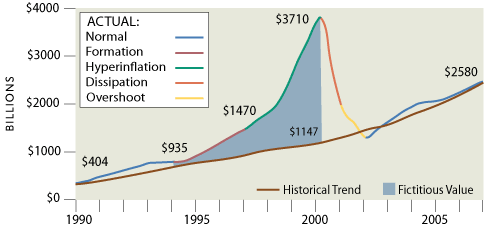
Total market value: NASDAQ. 11% annual growth derived from pre-bubble valuation (peak occurred March 10, 2000, when the NASDAQ traded as high as 5132.52 and closed the day at 5048.62).
I had a front-row seat to the Internet-stock mania of the late 1990s as managing director of Osborn Capital, a “seed stage” venture-capital firm founded by Jeffrey Osborn,4 with positions on the boards of more than half a dozen technology companies. I observed otherwise rational men and women fall under the influence of a fast-flowing and, it was widely believed, risk-free flood of money. Logic and historical precedent were pushed aside. I remember a managing partner of one firm telling me with certainty that if the company in which we’d invested failed, at least it had “hard assets,” meaning the notoriously depreciation-prone computer equipment the company had received in exchange for stock. A year after the bubble collapsed, of course, the market was flooded with such hard assets.
Deregulation had built the church, and seed money was needed to grow the flock. The mechanics of financing vary with each bubble, but what matters is that the system be able to support astronomical flows of funds and generate trillions of dollars’ worth of new securities. For the Internet, the seed money came from venture capital. At first, Internet startups were merely one part of a spectrum of enterprise-software and other technology industries into which venture capitalists put their money. Then a few startups like Netscape went public, netting massive returns. Such liquidity events came faster and faster. A loop was formed: profits from IPO investments poured back into new venture funds, then into new start-ups, then back out again as IPOs, with the original investment multiplied many times over, then finally back into new venture-capital funds.
The media stood by cheering, carrying breathless profiles of wunderkinder in their early twenties who had just made their first hundred million dollars; business publications grew thick with advertisements. The media barely questioned the fine points of the new theology. Skeptics were occasionally interviewed by journalists, but in general the public was exposed to constant reiterations of the one true faith. Government stood back—after all, there was little incentive for lawmakers to intervene. Members of Congress, who influence the agencies that oversee market-regulation functions, have never been unfriendly to windfall tax revenues, and the FIRE sector has very deep pockets. According to the donation-tracking website opensecrets.org, FIRE gave $146 million in political donations for the 2008 election cycle alone, and since 1990 more than $1.9 billion—nearly double what lawyers and lobbyists have donated, and more than triple the donations from organized labor.
Part of my job was to watch for the end-time, to maximize gains and guard the firm against sudden losses when the bubble finally popped. In March 2000, the signal arrived. One of our companies was investigating the timing of an IPO; the management team was hoping for April 2000. The representatives of one of the investment banks we talked to gave us a surprisingly specific recommendation that ran counter to advice offered by banks during the IPO-driven cycle of the preceding five years: they warned the company not to go public in April. We took the advice in the context of other indicators as a clear sign of a top, and over the next few months we liquidated stocks in public companies that we held as a result of earlier IPOs. Shortly thereafter, millions of investors with unrealized gains in mutual funds sold stock to raise enough cash to pay taxes on their capital gains. The mass selling set off a panic, and the bubble popped.
In a bubble, fictitious value5 goes away when market participants lose faith in the religion—when their false beliefs are destroyed as quickly as they had been formed. Since the early 1980s, the free-market orthodoxy of the Chicago School has driven policy on the upward slope of an economic boom, but we’re all Keynesians on the way down: rate cuts by the Federal Reserve, tax cuts by Congress, deficit spending, and dollar depreciation are deployed in heroic proportions.
The Internet boom had been a matter of abstract electrons and monetized eyeballs—castles in the sky translated into rising share prices. The new boom was in McMansions on the ground—wood and nails, granite countertops. The price-inflation process was traditional as well: there was way too much mortgage money chasing not enough housing. At the bubble’s peak, $12 trillion in fictitious value had been created, a sum greater even than the national debt.
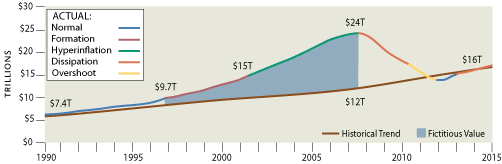
Total market value: Real estate. Actual market value from “Federal Reserve Flow of Funds Accounts of the United States.” Historical trend from Robert J. Schiller, Irrational Exuberance.
We certainly should have known better. Historically, the price of American homes has risen at a rate similar to the annual rate of inflation. As the Yale economist Robert Shiller has pointed out, since 1890, discounting the housing boom after World War II, that rate has been about 3.3 percent. Why, then, did housing prices suddenly begin to hyperinflate? Changes in the reserve requirements of U.S. banks, and the creation in 1994 of special “sweep” accounts, which link commercial checking and investment accounts, allowed banks greater liquidity—which meant that they could offer more credit. This was the formative stage of the bubble. Then, from 2001 to 2002, in the wake of the dot-com crash, the Federal Reserve Funds Rate was reduced from 6 percent to 1.24 percent, leading to similar cuts in the London Interbank Offered Rate that banks use to set some adjustable-rate mortgage (ARM) rates. These drastically lowered ARM rates meant that in the United States the monthly cost of a mortgage on a $500,000 home fell to roughly the monthly cost of a mortgage on a $250,000 home purchased two years earlier. Demand skyrocketed, though home builders would need years to gear up their production.
With more credit available than there was housing stock, prices predictably, and rapidly, rose. All that was needed for hypergrowth was a supply of new capital. For the Internet boom this money had been provided by the IPO system and the venture capitalists; for the housing bubble, starting around 2003, it came from securitized debt.
To “securitize” is to make a new security out of a pool of existing bonds, bringing together similar financial instruments, like loans or mortgages, in order to create something more predictable, less risk-laden, than the sum of its parts. Many such “pass-thru” securities, backed by mortgages, were set up to allow banks to serve almost purely as middlemen, so that if a few homeowners defaulted but the rest continued to pay, the bank that sold the security would itself suffer little—or at least far less than if it held the mortgages directly. In theory, risks that used to concentrate on a bank’s balance sheet had been safely spread far and wide across the financial markets among well-financed and experienced institutional investors.6
The U.S. mortgage crisis has been labeled a “subprime mortgage crisis,” but subprime mortgages were only a sideshow that appeared late, as the housing-bubble credit machine ran out of creditworthy borrowers. The main event was the hyperinflation of home prices. Risks are embedded in price and lurk as defaults. Even after the faith that supported a bubble recedes, false beliefs continue to obscure cause and effect as the crisis unfolds.
Consider the chemical industry of forty years ago, back when such pollutants as PCBs were dumped into the air and water with little or no regulation. For years, the mantra of the industry was “the solution to pollution is dilution.” Mixing toxins with vast quantities of air and water was supposed to neutralize them. Many decades later, with our plagues of hermaphrodite frogs, poisoned ground water, and mysterious cancers, the mistake in that logic is plain. Modern bankers, however, have carried this mistake into the world of finance. As more and more loans with a high risk of default were made from the late 1990s to the summer of 2007, the shared level of credit risk increased throughout the global financial system.
Think of that enormous risk as ecomonic poison. In theory, those risk pollutants have been diluted in the oceanic vastness of the world’s debt markets; thanks to the magic of securitization, they are made nontoxic and so pose no systemic risk. In reality, credit pollutants pose the same kind of threat to our economy as chemical toxins do to our environment. Like their chemical counterparts, they tend to concentrate in the weakest and most vulnerable parts of the financial system, and that’s where the toxic effects show up first: the subprime mortgage market collapse is essentially the Love Canal of our ongoing risk-pollution disaster.
Read the front page of any business publication today and you can see the mess bubbling up. In the United States, Merrill Lynch took a $7.9 billion hit from its mortgage investments and experienced its first quarterly loss since 2001; Morgan Stanley, Bear Stearns, Citigroup, along with many other U.S. banks, have all suffered major losses. The Royal Bank of
Scotland Group was forced to write down $3 billion on credit-related securities and leveraged loans, and Japan’s Norinchukin Bank suffered $357 million in subprime-related losses in the six months prior to September 2007. Even more of this pollution will become manifest as home prices continue to fall.
The metaphor is not lost on those touched by debt pollution. In December 2007, Chip Mason of Legg Mason, one of the world’s largest money managers, said that the U.S. Treasury should put $20 billion into a “structured investment vehicles superfund” to boost investor confidence.
As more and more risk pollution rises to the surface, credit will continue to contract, and the FIRE economy—which depends on the free flow of credit—will experience its first near-death experience since the sector rose to power in the early 1980s. Because all asset hyperinflations revert to the mean, we can expect housing prices to decline roughly 38 percent from their peak as they return to something closer to the historical rate of monetary inflation. If the rate of decline stabilizes at between 6 and 7 percent each year, the correction has about six years to go before things stabilize, leaving the FIRE economy in need of $12 trillion. Where will that money be found?
Bubbles are to the industries that host them what clear-cutting is to forest management. After several years of recession, the affected industry will eventually grow back, but slowly—the NASDAQ, for example, at 5,048 in March 2000, had recovered only half of its peak value going into 2007. When those trillions of dollars first die and go to money heaven, the whole economy grieves.
The housing bubble has left us in dire shape, worse than after the technology-stock bubble, when the Federal Reserve Funds Rate was 6 percent, the dollar was at a multi-decade peak, the federal government was running a surplus, and tax rates were relatively high, making reflation—interest-rate cuts, dollar depreciation, increased government spending, and tax cuts—relatively painless. Now the Funds Rate is only 4.5 percent, the dollar is at multi-decade lows, the federal budget is in deficit, and tax cuts are still in effect. The chronic trade deficit, the sudden depreciation of our currency, and the lack of foreign buyers willing to purchase its debt will require the United States government to print new money simply to fund its own operations and pay its 22 million employees.
Our economy is in serious trouble. Both the production-consumption sector and the FIRE sector know that a debt-deflation Armageddon is nigh, and both are praying for a timely miracle, a new bubble to keep the economy from slipping into a depression.
We have learned that the industry in any given bubble must support hundreds or thousands of separate firms financed by not billions but trillions of dollars in new securities that Wall Street will create and sell. Like housing in the late 1990s, this sector of the economy must already be formed and growing even as the previous bubble deflates. For those investing in that sector, legislation guaranteeing favorable tax treatment, along with other protections and advantages for investors, should already be in place or under review. Finally, the industry must be popular, its name on the lips of government policymakers and journalists. It should be familiar to those who watch television news or read newspapers.
There are a number of plausible candidates for the next bubble, but only a few meet all the criteria. Health care must expand to meet the needs of the aging baby boomers, but there is as yet no enabling government legislation to make way for a health-care bubble; the same holds true of the pharmaceutical industry, which could hyperinflate only if the Food and Drug Administration was gutted of its power. A second technology boom—under the rubric “Web 2.0”—is based on improvements to existing technology rather than any new discovery. The capital-intensive biotechnology industry will not inflate, as it requires too much specialized intelligence.
There is one industry that fits the bill: alternative energy, the development of more energy-efficient products, along with viable alternatives to oil, including wind, solar, and geothermal power, along with the use of nuclear energy to produce sustainable oil substitutes, such as liquefied hydrogen from water. Indeed, the next bubble is already being branded. Wired magazine, returning to its roots in boosterism, put ethanol on the cover of its October 2007 issue, advising its readers to forget oil; NBC had a “Green Week” in November 2007, with themed shows beating away at an ecological message and Al Gore making a guest appearance on the sitcom 30 Rock. Improbably, Gore threatens to become the poster boy for the new new new economy: he has joined the legendary venture-capital firm Kleiner Perkins Caufield & Byers, which assisted at the births of Amazon.com and Google, to oversee the “climate change solutions group,” thus providing a massive dose of Nobel Prize–winning credibility that will be most useful when its first alternative-energy investments are taken public before a credulous mob. Other ventures—Lazard Capital Markets, Generation Investment Management, Nth Power, EnerTech Capital, and Battery Ventures—are funding an array of startups working on improvements to solar cells, to biofuels production, to batteries, to “energy management” software, and so on.
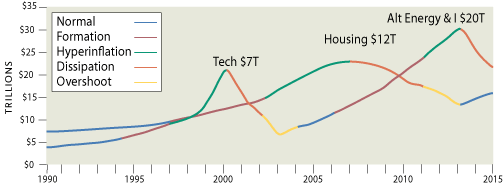
Total market value: Alternative energy and infrastructure. Estimated fictitious value of next bubble compared with previous bubbles.
The candidates for the 2008 presidential election, notably Obama, Clinton, Romney, and McCain, now invoke “energy security” in their stump speeches and on their websites. Previously, “energy independence” was more common, and perhaps this change in terminology is a hint that a portion of the Homeland Security budget will be allocated for alternative energy, a potential boon for startups and for FIRE.
More valuable than campaign rhetoric, however, is legislation. The Energy Policy Act of 2005, a massive bill known to morning commuters for extending daylight savings time, contained provisions guaranteeing loans for alternative-energy businesses, including nuclear-power technology. The bill authorizes $200 million annually for clean-coal initiatives, repeals the current 160-acre cap on coal leases, offers subsidies for wind energy and other alternative-energy producers, and promises $50 million annually, over the life of the bill, for a biomass grant program.
Loan guarantees for “innovative technologies” such as advanced nuclear-reactor designs are also at hand; a kindler, gentler nuclear industry appears to be imminent. The Price-Anderson Nuclear Industries Indemnity Act has been extended through 2025; the secretary of energy was ordered to implement the 2001 nuclear power “roadmap,” and $1.25 billion was set aside by the Department of Energy to develop a nuclear reactor that will generate both electricity and hydrogen. The future of transportation may be neither solar- nor ethanol-powered but instead rely on numerous small nuclear power plants generating electricity and, for local transportation, hydrogen. At the state and local levels, related bills have been passed or are under consideration.
Supporting this alternative-energy bubble will be a boom in infrastructure—transportation and communications systems, water, and power. In its 2005 report card, the American Society of Civil Engineers called for $1.6 trillion to be spent over five years to bring the United States back up to code, giving America a grade of “D.” Decades of neglect have put us trillions of dollars away from an “A.” After last August’s bridge collapse in Minnesota, it took only a week for libertarian Robert Poole, director of transportation studies for the Reason Foundation, to renew the call for “highway public-private partnerships funded by tolls,” and for Hillary Clinton to put forth a multibillion-dollar “Rebuild America” plan.
Of course, alternative energy and the improvement of our infrastructure are both necessary for our national well-being; and therein lies the danger: hyperinflations, in the long run, are always destructive. Since the 1970s, U.S. dependence on foreign energy supplies has become a major economic and security liability, and our superannuated roadways are the nation’s circulatory system. Without the efficient transit of gasoline-powered trucks laden with goods across our highways there would be no Wal-Mart, no other big-box stores, no morning FedEx deliveries. Without “energy security” and repairs to our “crumbling infrastructure,” our very competitiveness is at stake. Luckily, Al Gore will be making principled venture capital investments on our behalf.
The next bubble must be large enough to recover the losses from the housing bubble collapse. How bad will it be? Some rough calculations7: the gross market value of all enterprises needed to develop hydroelectric power, geothermal energy, nuclear energy, wind farms, solar power, and hydrogen-powered fuel-cell technology—and the infrastructure to support it—is somewhere between $2 trillion and $4 trillion; assuming the bubble can get started, the hyperinflated fictitious value could add another $12 trillion. In a hyperinflation, infrastructure upgrades will accelerate, with plenty of opportunity for big government contractors fleeing the declining market in Iraq. Thus, we can expect to see the creation of another $8 trillion in fictitious value, which gives us an estimate of $20 trillion in speculative wealth, money that inevitably will be employed to increase share prices rather than to deliver “energy security.” When the bubble finally bursts, we will be left to mop up after yet another devastated industry. FIRE, meanwhile, will already be engineering its next opportunity. Given the current state of our economy, the only thing worse than a new bubble would be its absence.